
Expensive Mistakes
POISONING THE WELL
HOUSEKEEPING
Another reworked retread that may sound familiar to long-time readers
Over the past few weeks, we’ve looked at how the fitness and diet industries have turned what should be simple—moving your body, eating well—into a complex, expensive, deceitful enterprise. We’ve examined how this creates a fitness wealth gap: not between rich and poor, but between those who’ve managed to cut through the noise and connect cause and effect—building genuine fitness and health—and those lost in the marketing fog, spinning their wheels despite their best efforts.
But there’s a third pillar propping up this ecosystem, one that makes our previous subjects look respectable by comparison—less a complement than a collaborator.
An industry perhaps better described as a third wheel, because if ever there was a solution in search of a problem…
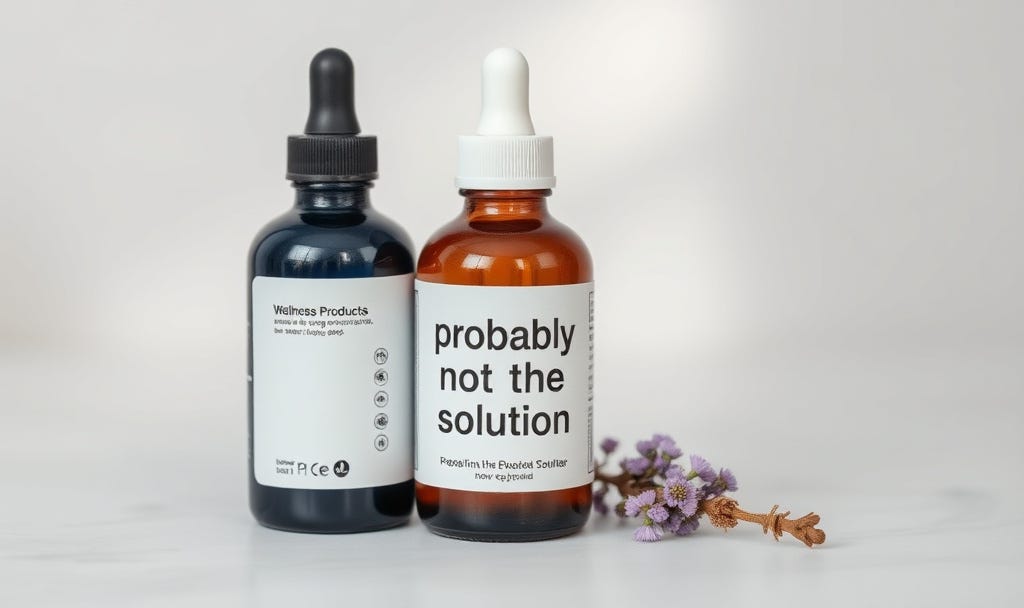
It is ‘wellness.’
“Thank you, but I am not interested in ‘X’. This is nothing against the product— I have no knowledge of it. I choose not to have any affiliation with supplements (or any other products), for the simple fact that it compromises my authority.
My advice to clients comes from a position that has no self-interest beyond seeing them succeed - and they know that. This lends my recommendations a weight immediately compromised by any affiliation— the quality of which is immaterial.”
That is the canned email response I deliver, at least fortnightly, to companies offering me various ways and means to “optimise the hormones,” “detoxify the cells,” “unlock the vitality,” and “torch the fat” of my clients.
It affords most a respect rarely due.
The legitimacy of the products on offer varies, but— as those examples will hopefully make clear — it is no exaggeration to say that most approaches are made on the pretext that I’m a complete idiot. So it’s hard to be polite. Especially when these products would do exactly nothing for my clients. But only if we were lucky.
Because wellness is the Wild West, and a significant portion of supplements contain unlisted ingredients, undisclosed contaminants, and, in some cases, compounds that cause genuine medical harm. But that’s almost beside the point, because these aren’t just sales pitches, they’re symptoms of a much larger problem: an industry built on manufactured need and optimisation anxiety.
People are overwhelmed and want to feel better. The promise of a shortcut isn’t just seductive but often the only thing that feels achievable when you’re stretched thin. No judgement. The problem isn’t the people buying—it’s the industry built to exploit that hope.
Yes, legitimate medical supplementation exists. Yes, elite athletes use scientifically supported supplements for genuine incremental gains. Yes, a much shorter list helps the general population when the big rocks—training, nutrition, sleep—are in place. And yes, there are evidence-based activities—meditation, stress reduction practices, preventive care—that have real value.
That’s not what we’re talking about. That’s not what’s flooding my inbox. None of these minuscule markets makes up a $200 billion industry. If we generously assume half falls into the legitimate categories above (highly unlikely), we’re still left with at least $100 billion worth of bullshit.
BUT WHAT THE HELL IS WELLNESS?
Round up the celebrity suspects, and you’ll discover it’s “a holistic, often luxurious, lifestyle that integrates physical, mental, and spiritual well-being.”
Right.
But even if we look to more trustworthy sources, we get much the same word salad. According to the National Wellness Institute (USA), wellness is “an active process through which people become aware of, and make choices toward, a more successful existence.” A definition based on three tenets:
Wellness is considered a conscious, self-directed and evolving process of achieving full potential.
Wellness is multi-dimensional and holistic, encompassing lifestyle, mental and spiritual well-being, and the environment.
Wellness is positive and affirming.
A very broad brush. Less a definition than a permission slip. And all subjective enough for that one word to smuggle in every form of quackery you imagine, and thousands more you can’t.
Because you’d think a wellness industry—with its $200 billion war chest—would have something to show for itself by now, but where is the societal uptick in wellness? Where are these bright, shiny examples of health, vitality, and “optimised” existence?
Like its fitness and dietary brethren, there is little other than a suspicious lack of impact. As long lamented and detailed in many posts here, our physical capacity diminishes, life expectancy declines, and obesity rises. A physical devolution that takes an associated psychological toll, so that certainly tracks with a corresponding rise in mental health disorders.
But consider further that, like the market for snake oil, tonics and elixirs—once literal sideshows at travelling circuses, where the charlatans had to keep moving before anyone noticed the product didn’t work—the behemoth that is the modern wellness industry operates on one fundamental premise:
YOU ARE SICK
Behind the facade of green smoothies and detox diets, you’ll find that same single premise propping up the lot of it.
Pathologising the ordinary:
Feel tired after a long day?
Bloated after a big meal?
Don’t sleep perfectly every night?
Make no mistake. Any minor fluctuation in mood, energy, or physiology means you are broken, or— just as bad— suboptimal.
But fear not, you can be fixed.
And you better believe that. Because that’s the ‘life-affirming, multi-dimensional and holistic, conscious, self-directed and evolving’ hinge this industry is swinging on.
I don’t make light of those who are genuinely unwell. Those who have undiagnosed conditions, chronic illnesses, or legitimate health concerns requiring appropriate diagnosis, treatment, and support. This industry will exploit them as much as the next, but by marketing vague, unfalsifiable claims, it primarily targets the worried well—people who are essentially healthy but can be convinced they’re not.
Worse still, if you’re intent on uncovering a problem, it’s not just that you’ll always find one—the nocebo effect makes it likely you’re creating one. That’s why your doctor tells you to stay away from Dr Google. We are suggestible enough that given any list of general symptoms, we will all turn a sore finger into a brain tumour by the end of the page.
Wellness offers this same palm-reading of generalities that predictably point to a ‘solution’. The result isn’t merely ineffectiveness, but a perpetual state of anxiety, stress, self-doubt and rumination.
All legitimate health hazards.
CREDIT FRAUD
And then the real sleight of hand: when people do feel better after using a wellness product, it’s seldom because the product works, but because they’ve started paying attention to themselves.
They’re prioritising sleep. They’re drinking more water. They’re thinking about what they eat. They’re moving more. The supplement didn’t do that—the decision to change did.
And while there is a case to be made here for a placebo or indeed any ultimately beneficial outcome, the problem is not the wellness industry claiming the win, but a misattribution of cause and effect that condemns us to a cycle of hope, anxiety and expenditure.
Learned helplessness and dependence.
All of this confusion—products, protocols, and promises—muddy the waters for anyone genuinely trying to improve their health. But there are a couple of fail-safe bullshit detectors.
1. Examine.com – If you have any doubts (and you should) about your potion, powder, tincture or herb, start here. It’s independent, evidence-based, and—critically—has no incentive to sell you anything. (For those with a short memory - no, I don’t have any affiliation)
2. The “Email Scam” Rule – if it looks too good to be true, it probably is. Any product that claims to excuse, absolve, or magically shortcut the work of dietary health, exercise, or lifestyle adjustment won’t. Because it can’t.
Because of a simple, unassailable truth:
Your body reflects what you do with it.
It reflects the work. It reflects the avoidance of work. Exactly. Every time. All the time. There is no substitute or supplement for the physical requirements of your body. Read that again. Make sure it sinks in. It’ll save you a lot of extremely expensive urine. If you are lucky.
If you have any designs on ‘optimal’, it’s the basics like regular GP check-ups, common sense like taking care when getting in and out of the shower, and—not to put too fine a point on it — maintaining an ongoing practice of exercise, dietary health and wider lifestyle behaviours that are how you go about it.
The more time you spend chasing optimal, the less time you spend on fundamentals. Every minute you spend researching adaptogen blends or comparing magnesium types is a minute not spent cooking a proper meal or going to bed on time. The time, money and energy that could be invested in the simple, proven basics, swallowed by a maze of competing, mostly useless interventions.
SIGNS OF LIFE
The wellness industry takes that fundamental truth from last week—that an unhealthy person has only one problem—and weaponises it. A psychological crowbar framing all of it not as some shallow consumer sentiment but an obligation. A responsibility.
But if you are truly interested in wellness, there’s a final timely test.
Thanksgiving is, in theory, a moment of gratitude for what you have. A reminder of sufficiency. Twenty-four hours later, that sentiment is trampled by Black Friday—the annual ritual built on the opposite premise: you are not enough, and salvation can be purchased at 40% off.
The wellness industry has perfected this interception: gratitude replaced by manufactured lack, contentment disrupted by anxiety. An American-centric metaphor, certainly, but it’s always struck me as one of the better reasons for a day off—and a useful lens through which to examine your approach to health. So if you are truly interested in wellness, ask yourself which one of those days you are aligned with—because if you’re looking to get what you want from your body and mind, you’ve already answered.
I want to look like this. I want to do that. I want to feel this. I want. I want. I want.
Just like the pursuit of ‘happiness’, any pursuit of ‘wellness’ implies its absence before the journey even starts. And while you may well want all those things, none of that is your department. Jesus, is it any wonder you’ve got a headache?
You are responsible for the following:
Giving.
Gift yourself good quality sleep, good quality food, and the movement and stress your skeletal, muscular, nervous and endocrine systems demand, none of which you’ll find in a bottle.
Then see what happens.
Even then, accept the aches and pains, periodic anxiety, and sadness—and every other experience that might not fall into a ribbon-wrapped definition of ‘optimal’—the intermittent illness, crankiness, or blues on a grey day— they are all classic symptoms indicating you are suffering from nothing other than a textbook case of life.
And there is only one cure for that.
____
Enjoy your weekend.
- OLI