
Normal Programming
AND GIFTS THAT KEEP ON GIVING
HOUSEKEEPING
A final rework to cap off this series, and indeed the year.
And the so-called real world will not discourage you from operating on your default settings.
— David Foster Wallace, This Is Water (required reading)
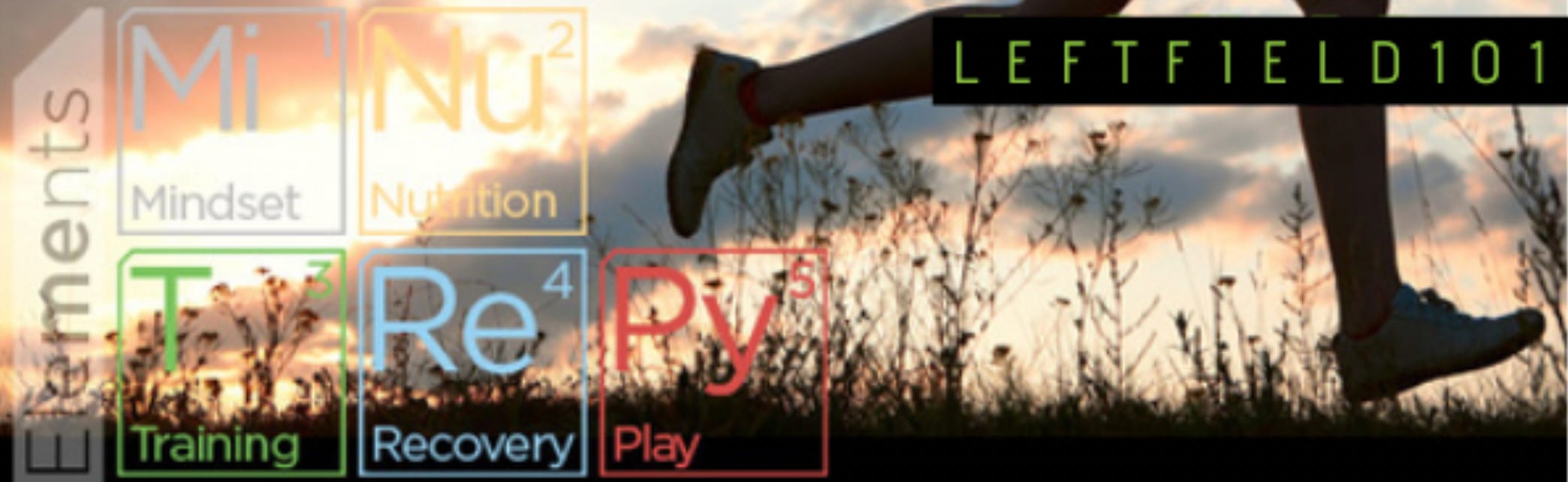
There’s a good reason Mindset sits at #1 on the 101 header (above).
Not a hierarchy, it’s not more important than the others, but more an(other) order of operations. So we start with mindset— although Play being last is not the least of our concerns, but the greatest. If Play sounds juvenile, think of it as the great play: life itself— and your capacity to engage in it.
And so everything is purposed towards that end:
We’re not eating well for the sake of it.
Not training to be better at exercise.
Not sleeping just to claw our way back to baseline
And we, sure as hell, are:
Not moving just to “burn calories.”
But, like so much in life, it all comes down to how you start and your mindset will set up, or upset, all of it.
Hardly a revelation. But even on recognising it as such, we still look only to the (admittedly still important) curation of our individual thoughts, while rarely considering— indeed ever seeing, as Foster Wallace alludes to in the full speech linked above— the bigger picture.
As Ellen Langer’s famous Counter-clockwise experiment (1979-81) demonstrated, your environment, both physical and psychological (culture), is the most powerful sculptor of behaviour. Taking a group of older men to a residential retreat recreated to look and feel exactly like it was 20 years earlier—music, magazines, décor, everything— they were instructed to act as if it were actually 1959, speaking, behaving, and interacting as their younger selves.
Showing measurable improvements in strength, posture, flexibility, memory, and vision, they even appeared younger after just one week.
Wherever you put your mind, the body follows. This obvious extension of the placebo effect warns that we should first acknowledge the influence of cultural and societal expectations on our health, and then choose whether to accept them.
Because much of what now passes for normal is doing you no favours. In the past, ‘normal’ served as a guardrail helping to keep us on the straight and narrow.
[I’m talking our more recent past here as a highwater mark, and am not suggesting human history generally has cultivated ‘health’ by any modern measure]
But once upon a time:
More people would be healthy than not.
More people would be fitter than not.
And more people would eat real food in reasonable portions than not.
Not one of those 3 statements now stands. Not one is statistically normal.
We haven’t merely taken fitness for granted. Even that would be a huge improvement on a pendulum swing where ill health isn’t just defended but, in some circles, celebrated. Framed as empowerment. Framed as self-care.
A status-quo stranger still in that I’m compelled to clarify the bloody obvious and that my arguing against this madness is not my arguing for shame, belittlement or exclusion.
But we’re not going down the culture wars rabbit hole today, and this is not a soapbox. It’s not even an argument for you to change. You should do whatever the hell you want, but— and here’s the crucial bit— how’s that working for you?
Because much of what we deem normal is bullshit. And optional.
Middle-aged spread: the myth of slowing metabolism.
Constantly looking at your phone.
Eating processed crap.
And too much of it.
Feeling like shit.
Hating exercise.
Only distracting yourself sufficiently enough to do nothing about it.
You know what’s weird? Someone who doesn’t do even one of those things.
So the upside— if you want to call it that— is you can wrap yourself in the warm blanket that, yes, all of this is normal. If that doesn’t leave you cold, further realise that the longer these norms are accepted, they are not neutral.
In The Mindbody Self, Dr Mario Martinez argues that many things we attribute to age—more stress, more food, less movement— and just like other cultural norms—are a self-fulfilling prophecy.
You expect to get fat— and it’s culturally expected (and accepted)— so you do.
While this book occasionally dips into Deepak Chopra territory— that of grand, yet unverified (or unverifiable), claims— but much more of it is as self-evident as it is unappreciated. To recognise that the power of placebo and nocebo and their positive or negative influence on your physiology, respectively, is woven through not just medical or health-specific situations, but every story.
In 2011, another study showed that participants’ hunger and satiety tracked with what they believed they’d consumed, not the actual nutritional value. A label (the story) determined the physiological response. [Which— unless a cull is the point of the exercise—makes warnings on cigarette packets a monumentally bad idea.]
And these stories are everywhere: Cultural portals, as Martinez describes them, that we are funnelled through, with every norm exerting a gravitational pull until even the idea of resisting becomes a fantasy.
But it begins with first seeing it as story. And choosing to adopt or defy it. On the understanding that whatever the story— like the one you’ll have about exercise— it’s not just there. You’re living into it. It determines both where you are now and where you will be.
Perhaps we have simply reached the zenith of physicality, and our tomorrows find us existing as disembodied consciousness yoked to some AI.
If you think that sounds grim, consider if that’s not the case.
With this environment and these cultural norms shaping behaviour, what do you think your kids’ normal is going to be? Already is? With technology increasingly able to preserve life in the absence of health, we’ll be yoked to machines in either case.
Over the past few weeks, I’ve written about the cult of consumption in fitness, a developing fitness ‘wealth’ gap, and the dangers of wellness. All of them light on solutions. Intentionally so.
Because it first all boils down to the same antidote: a rejection of normal.
The behaviours, expectations, and scripts we absorb without question. The settings handed to us by culture, environment, peers, industries, and convenience—running in the background, shaping every decision.

So if you’ve had enough of being normal, Leftfield Training stands as a counterpoint.
The bad news? No shortcuts, hacks or anything else that might otherwise be deemed ’normal’ in the conventional approach. No miracles. No secrets.
If that doesn’t sound too appealing, I’d only point out that being normal doesn’t absolve you of effort either. Sooner and later, you’ll find it’s hard work being normal.
The silver lining is that, with the bar set so low, it’s never been easier to get yourself on the right side of that fitness wealth gap—to be elite. Simply addressing the basic needs of body and mind shifts you to the low-ceiling end of the bell curve - the outlier.
Swimming against a tide of cultural norms makes this far harder than it needs to be, but we endeavour to do so nonetheless, knowing any progress along this contrary path will, inescapably, make us healthier, happier and more fit for purpose— living— than anyone might hope for mired in the prevailing zeitgeist.
And by getting body and mind aligned, you’ll soon realise you’re (finally) no longer swimming against the tide, but floating downstream.
Not normal.
Supernormal.
THE GIFTS THAT KEEP ON GIVING
Rejecting normal— not as some abstract philosophical stance, but as the most pragmatic path forward— is the only way you avoid becoming the statistical average. An average that’s getting worse every year.
And it gets worse every year, at this time every year.
One more line of code most people follow automatically is the preloaded assumption that holidays and health can’t coexist. That gaining fat is inevitable. That celebration and self-respect are mutually exclusive. That you can either enjoy yourself or avoid damage—but not both.
‘Holiday weight gain’— as they call it in the studies. The 1-3kg of fat typically gained over the next month and never lost. To head that off at the pass— and enjoy a better festive season to boot— BEFORE AND STILL is now open. A 45-60 minute consulting call, arming you with a far better strategy over the holidays.
Book your call from Mon-Thurs next week, so you’re ready to start Friday.
NO MORE NORMAL
And if you’re stuck for last-minute gift ideas, you could do a lot worse than GIVE SOMEBODY A FITNESS PRACTICE, right?
Leftfield Training gift vouchers are available with a 6-week minimum:
Burnley Group: 61/wk
Online 67/wk
[If the lucky recipient is on the fence, the trial period still applies and, should they determine Leftfield is not for them, the voucher is transferable within that trial period]
And that is that. The next post won’t hit your inbox until Saturday, January 11th.
So until then, I wish you and your loved ones a Merry Christmas and a safe and happy New Year.
As ever, thanks for reading.
- OLI